


The Map Has Been Redrawn
For most of human history, the deal was straightforward. You were born. If you survived childhood — which was far from guaranteed — you worked hard, physically, for most of your life. Then you got old quickly and died.
Life expectancy has more than doubled in two centuries. But here’s the thing almost nobody talks about: that isn’t because people got fitter. It’s because they stopped dying young of things that had nothing to do with fitness.
The rise in life expectancy came from clean water, sanitation, vaccines, antibiotics, and improvements in neonatal care. As a Harvard medical historian bluntly put it, most people credit medical advances for the increase — but most historians would not. The steepest rise occurred from the late 1800s to the mid-1900s, before most of the effective treatments we recognise today even existed.
Our great-grandparents didn’t die young because they were unfit. They died young because infections killed them. Medicine fixed that. We got more years.
What medicine couldn’t fix — what nobody even thought to address — was what we’d do with them.
Longer Lives. The Same Old Ending.
Although people may live longer now, many are doing so with poorer physical function and reduced quality of life. We extended lifespan. We didn’t automatically extend healthspan — the years in which you are strong, capable, independent, and fully alive.
The generations before ours moved more through necessity. In the early 1960s, almost half of jobs required at least moderate physical activity. By the 2000s, fewer than 20% demanded that level of exertion, and daily work-related energy expenditure had dropped by over 100 calories for both men and women. Before that, people were out in fields, mines, and factories. Their bodies were working.
But that movement was incidental. It came from labour, not from intention. And it stopped when the labour stopped. Nobody was training at 65 with the explicit goal of staying strong into their 80s. The concept simply didn’t exist.
The latter part of the 20th century brought rapid technological advancement — computers, smartphones, digital devices — leading to a significant increase in sedentary behaviour. We engineered the physical work out of our days and replaced it with screens. We got longer lives and softer bodies.
That’s the world most people are navigating right now. More years, but no guarantee of good ones.
The Pioneers
Here is where something genuinely new is happening.
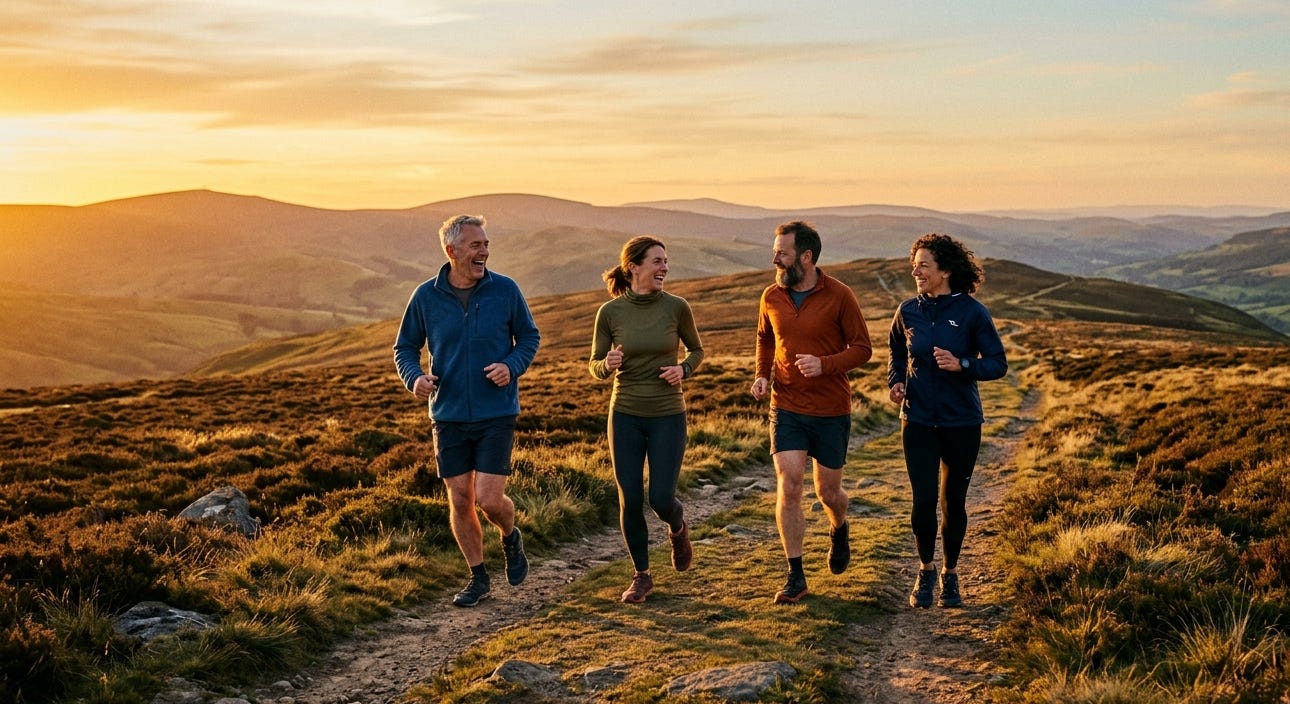
A generation of people is doing something with no real historical precedent. Not working hard because they have to. Not staying active by accident. But deliberately, consistently, structurally training into their 40s, 50s, 60s and beyond — with the specific intention of closing the gap between how long they live and how well they live.
The science on what this does is striking.
Sedentary adults lose aerobic capacity at roughly 12% per decade. Masters athletes who keep training lose it at around 5.5% per decade — less than half the rate. Lifelong aerobic exercise cuts the age-related loss of muscle volume by around 50%, and the infiltration of fat into muscle tissue — one of the quiet markers of physical decline — is also reduced by around 50%.
Masters athletes show markedly greater physiological function and more favourable risk profiles for cardiovascular disease, osteoporosis, frailty, and cognitive decline than their sedentary counterparts. Researchers have gone as far as saying that studying this group puts ageing back into the domain of physiology rather than clinical medicine. Which is another way of saying: what looks like inevitable decline is, in many cases, a lifestyle outcome.
And it’s never too late to begin. A study comparing masters endurance runners who had trained all their adult lives with those who only took it up after the age of 50 found no meaningful difference in athletic performance or physical composition between the two groups — despite a 30-year gap in training history.
The Gap Nobody Warned Us About
There’s a question worth sitting with — whether you’ve just sold a business, taken early retirement, stepped back from a career, or simply reached the point where you’re asking what the second half actually looks like.
We were sold an idea. Work hard, build something worth having, get out at the right time, and life after that is the reward. For many of us, getting out was exactly the right call.
But nobody warned us about the gap. The gap between the age at which you finish and the age at which, if you’ve looked after yourself, you might still be very much alive and capable. That gap could be 30 years. It could be 40.
What fills it matters. Not just financially — though we’ve written about that — but physically. The person who achieves a remarkable exit, or a clean and early retirement, and then spends the next two decades in gradual decline has, in a very real sense, won the wrong game.
Life to Your Years
I can’t tell you that what I do will add years to my life. Nobody can make that promise. What I can tell you is that it is adding life to my years — and at 56, with 80-odd marathons and ultras behind me and more ahead, I feel that difference every single day.
I started running in 2016, slowly and reluctantly, after a health event I couldn’t ignore. I had no idea what I was beginning. I’m now in the best physical shape of my life. That isn’t a boast. It’s evidence — not just of what the body can do, but of what happens when you commit to the long game and refuse to let the calendar make your decisions for you.
We are, I think, the first generation with both the longevity and the knowledge to do this differently. Not the generation that worked hard physically because they had no choice. Not the generation that sat down when the work stopped. Pioneers. Opening up territory that nobody before us ever reached, because they never had the years, the science, or the option.
The map has been redrawn.
The question is whether you’re going to explore it.
Thanks for reading The Long Run Mindset! This post is public so feel free to share it.
If you’ve enjoyed this and not yet subscribed, the best thing you can do to help is hit the button below — it takes ten seconds and it means the world. There’s a paid tier too if you ever want more, but free is absolutely fine and genuinely helpful. 👇