


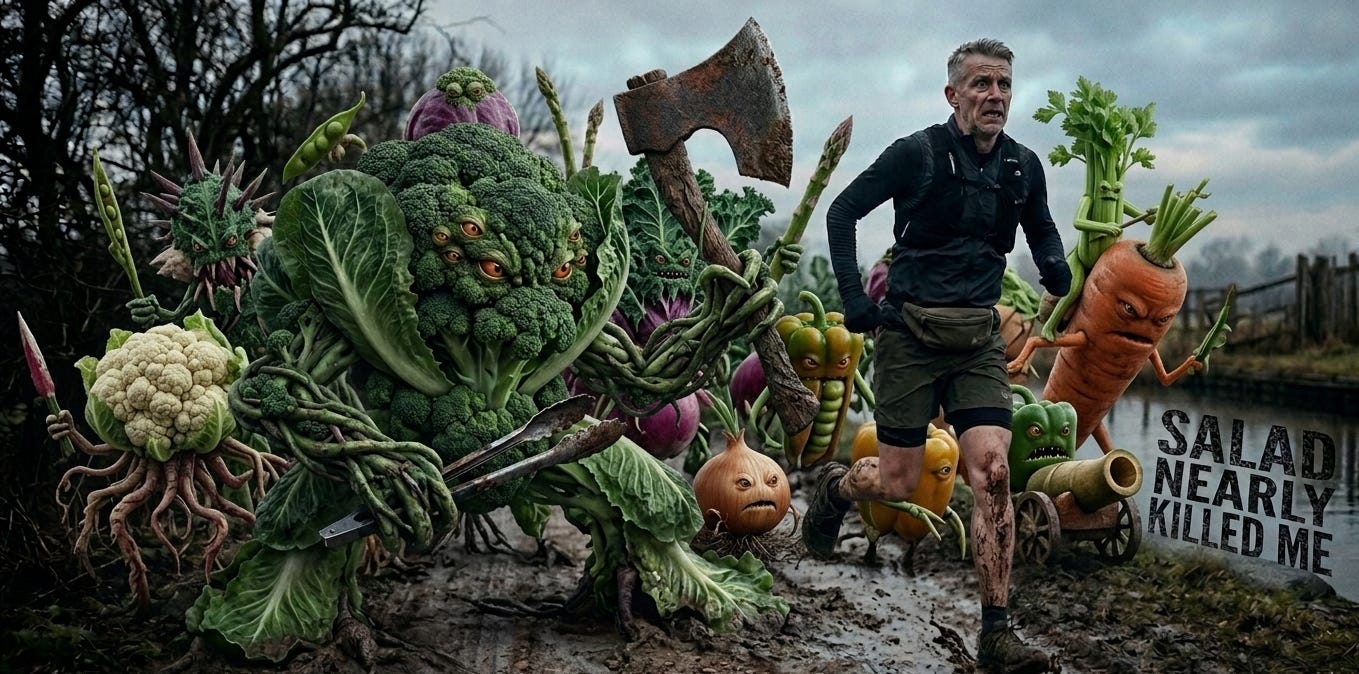
I was twenty-one when they told me I had Crohn’s disease.
I nodded, took the leaflet, and got on with my life.
That was a mistake.
The Advice That Should Have Finished Me
Crohn’s is a disease of the digestive system. It inflames, it scars, it blocks. It makes eating — one of the most basic human acts — an exercise in anxiety and pain.
In the early years I managed it the only way I knew how. Painkillers. Willpower. Ignoring things that deserved my attention.
Then came the advice that still stops me when I think about it.
My consultant sat Catherine down — my wife, red haired, practical, the person who has always seen things more clearly than me — and told her something extraordinary.
Feed him McDonalds. Junk food passes through easier. A salad could cause a blockage.
A doctor. A qualified medical professional. Telling my wife that processed food was the safer option.
And here’s the thing — he was right. For a damaged, scarred, narrowed digestive system, ultra processed food was genuinely easier to manage than fresh vegetables. The system was so broken that the food designed to destroy it had become the food keeping it going.
So that’s what I ate.
Burgers without sesame buns — too risky. Fry-ups with half the plate missing — no beans, no tomatoes, no mushrooms. Food reduced to whatever would pass through without causing a crisis.
The weight piled on. Of course it did. A junk food diet with a body that couldn’t exercise properly was only ever going to go one way.
And Crohn’s does something else that nobody tells you about. It saps your energy in a way that’s hard to explain. When your digestive system is compromised you’re not absorbing nutrients properly. You’re eating but you’re not fuelling. You feel perpetually half empty — tired in a way that sleep doesn’t fix.
I was overweight, exhausted, and medically instructed to eat McDonald’s.
That is not a life worth living.
The Price of a Normal Life
But here’s the thing about chronic illness that nobody talks about.
You will do almost anything to feel normal.
For years I went out for meals. Birthday dinners. Christmas tables. Celebrations I couldn’t miss and wouldn’t miss. I’d sit down, order food, eat it — sometimes between courses — knowing with absolute certainty what was going to happen later.
When a proper meal hit the first restriction it was coming back up. Not a choice. Not a behaviour. Just biology. My body doing the only thing it could do when food met scar tissue.
I’d excuse myself quietly. Deal with it. Come back to the table.
Nobody knew. Or if they did they didn’t say.
I’m not telling you this for sympathy. I’m telling you because I want you to understand what Crohn’s actually costs — not in medical terms but in human ones. The price of a Christmas dinner. The price of being there. The price of pretending, for a few hours, that your body works like everyone else’s.
You pay it. Because the alternative is sitting at home while the world carries on without you.
The Year My Food Shop Was at the Chemist
Eventually even that stopped working.
The flare-ups got worse. The blockages more frequent. The pain bad enough that hospital became familiar — three admissions in three months, each one arriving with the same symptoms as appendicitis, each one frightening the people around me even after I’d stopped being frightened myself.
Then a year on a liquid diet.
My weekly food shop became a monthly trip to the chemist. Three prescribed drinks a day — nothing else. I’d walk out with so many boxes they were too heavy to carry in one go. A hundred cartons of beige nutrition, stacked in the hallway, keeping me alive but not much more than that.
I remember sitting at tables while everyone else ate. Being handed a menu and ordering nothing. The small daily indignity of a body that had stopped cooperating with the most ordinary things.
That’s not living. That’s just not dying.
If you’re finding this interesting, you can get The Long Run Mindset in your inbox every Tuesday — free. Subscribe below.
The Operating Table
After my third admission in three months my consultant ran out of patience.
It was time for surgery. A resection — they would remove the worst section, a metre of damaged intestine, and give me a fighting chance at something better.
I won’t dress it up. Surgery for Crohn’s is not a cure. The disease doesn’t disappear — it finds new territory. Resection after resection, each one removing more, until eventually there is nothing left to remove. I knew that going in.
What I also knew, lying in that hospital bed waiting for the anaesthetic, was that if I came out the other side and changed nothing — the stress, the diet, the sedentary life I’d been living — I would end up back on that table. And the table after that. And the one after that.
Two days in resus afterwards. In and out of consciousness. Catherine there.
When I came round properly I made a decision. Not dramatic. No lightning bolt. Just quiet and certain.
Something had to change. Three things, actually.
Less stress. Better food. Start moving.
Simple logic. No guru. No programme. No six week plan.
Just a man who had run out of excuses and almost run out of intestine.
What I Know Now
Crohn’s disease is not curable. I want to be clear about that.
But I haven’t had a flare-up in over a decade.
I eat a whole food plant based diet — the opposite of everything my consultant once recommended. I run every day. I manage my stress differently than I did at twenty-one, or thirty-one, or forty-one.
The consultant told Catherine to feed me McDonalds.
I haven’t eaten meat in years.
I don’t say that to be clever. I say it because the distance between those two sentences is the entire story of how a life can change — not in six weeks, not on a programme, not because someone sold me a transformation.
But slowly. Imperfectly. Over more years than I was counting.
One decision at a time.
Thanks for reading The Long Run Mindset! This post is public so feel free to share it.
If you’ve enjoyed this and not yet subscribed, the best thing you can do to help is hit the button below — it’s free and only takes ten seconds and it means the world.